

1. Have I learned something more about myself and life?
Celestine Chepchumba wrote, “As a student, I often think about the kind of future I want, and not just for myself, but for my community. If nothing changes, I fear my community will still be struggling with poverty, poor education, and social division in the years to come. But I am not ready to accept that outcome. I believe that with courage, hard work, and unity, my community can become prosperous. It all begins with what we do today.”
Esther Nasimiyu wrote, “In many parts of my community, the dreams of young girls are cut short by early marriages and teenage pregnancies. These practices not only rob girls of their childhood but also deny them the opportunity to pursue education and build a better future. As someone who understands the value of education and the importance of gender equality, I am committed to fighting this harmful cycle after graduating from university.”
Esther Chebet Ngeywo wrote, “I have a dream! My dream is to finish my university studies and open a school so that needy children in my community can have affordable, quality education. I will begin by registering a community-based organization for children in need because I also passed through a similar challenge.”
2. Have I pushed myself as a writer to be clear, using periods, commas, question marks, and exclamation points? Have I ended every thought with a punctuation mark and started the next sentence with a capital letter? (I made a few corrections below.)
Naibei Marion Chepkorir wrote, “I would work with schools, churches, and community leaders to introduce comprehensive reproductive health education in both formal and informal settings. Also, peer-to-peer education programs can be established, whereby trained young people educate their peers in a safe, relatable way. Parents would also be involved through workshops designed to help them talk more openly and be more effective with their children. This approach will reduce myths, misconceptions, and risky behavior among adolescents.”
Cherly Nafula Simiyu wrote, “The school will offer subjects like digital technology, basic finance, literacy, and agriculture, along with core subjects like math, science, and English. Parents will also be involved in our community school. For youths and parents, I will provide literacy classes and vocational training, which will help the community to grow together.”
3. Have I taken every opportunity to use imagery, analogies, and descriptive words? Here are a few opportunities to consider: Describe the struggle you see in your community, for example, children working in the fields rather than in school, or young adults wandering the streets without work or purpose…the hopelessness in their downcast eyes? Describe what the river looks like where people gather water, its color, or any debris or animals in the water. How do you envision your school, a rural or city location? Do you imagine children learning, singing, and playing…hopeful and motivated to learn? What would freedom from menstrual insecurity look like in your community? Do you envision happy, confident women and girls competing for high grades or succeeding in sports?
Marilina Nyabol wrote, “I will create awareness on the importance of farming, and by doing so, I hope to inspire others to join the fight against our common enemy: starvation.”
Gloria Awino, “Water is life. By investing in rainwater harvesting, safe storage, and low-cost purification, I will help my community overcome the water crisis. Through innovation, education, and unity, we can turn scarcity into abundance.”
Nyayow Gatkuoth wrote, “I want to plant the seeds of change and empower forgotten children. My vision is bold, but it is possible with unity and passion. Education is the most powerful weapon we can use to change the world, and now is the time to use it!”
Abigael Simiyu wrote, “Opening a school is not just an act of charity, but an investment in the future of my community. It is a way of planting seeds of hope that can grow into strong trees of opportunity. I will return, yes! I will return not just as a graduate, but as a change-maker, ready to build a school that builds lives!”
4. Finally, have I expanded the hearts and minds of others by sharing my story and who I am?
Mary Akoth wrote, “Rehabilitation is not merely about sheltering the homeless; it is about restoring their dignity and self-sufficiency. Solving this challenge is not just an act of charity; it is a moral obligation and a measure of our collective humanity.”
Ebby Angesa wrote, “Growing up in a community where poverty is widespread, I have witnessed many girls miss school regularly during their periods. Because they could not afford sanitary products, some resorted to using old rags, newspapers, or even nothing at all; practices that are not only uncomfortable and undignified, but also dangerous to their health. As a result, many girls fell behind in class, lost confidence, or even dropped out of school entirely.”
What great writing!!
Writing is exciting because it is an ongoing opportunity to learn, to think more deeply, and to share who you are – and to help others learn, think, and reflect, too. As you can see from the girls’ excerpts, they understand that writing and effective communication are powerful tools.
Here are the awards for our 11th Annual Writing Competition:
First Place Winner – $75 each for personal education:
- Mary Akoth
- Marilina Nyabol
- Gloria Awino
- Naibei Marion Chepkorir
Second Place Winner – $50 each for personal education:
- Nyayow Gatkuoth
- Ebby Angesa
- Celestine Chepchumba
- Esther Nasimiyu
Honorable Mentions – $25 each for personal education:
- Esther Chebet Ngeywo
- Cherly Nafula Simiyu
- Abigael Simiyu
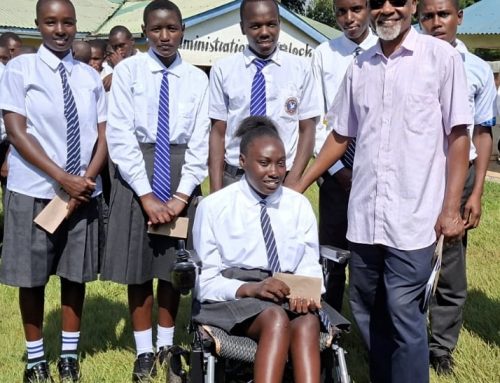
We congratulate all the students for showing courage and dedication in entering the Competition. From our hearts, we see every one of them as a winner, and always look forward to reading and commenting on more of their writing. Here are a few photos from the awards ceremony, and one of the winning essays by Gloria Awino.


Leave A Comment